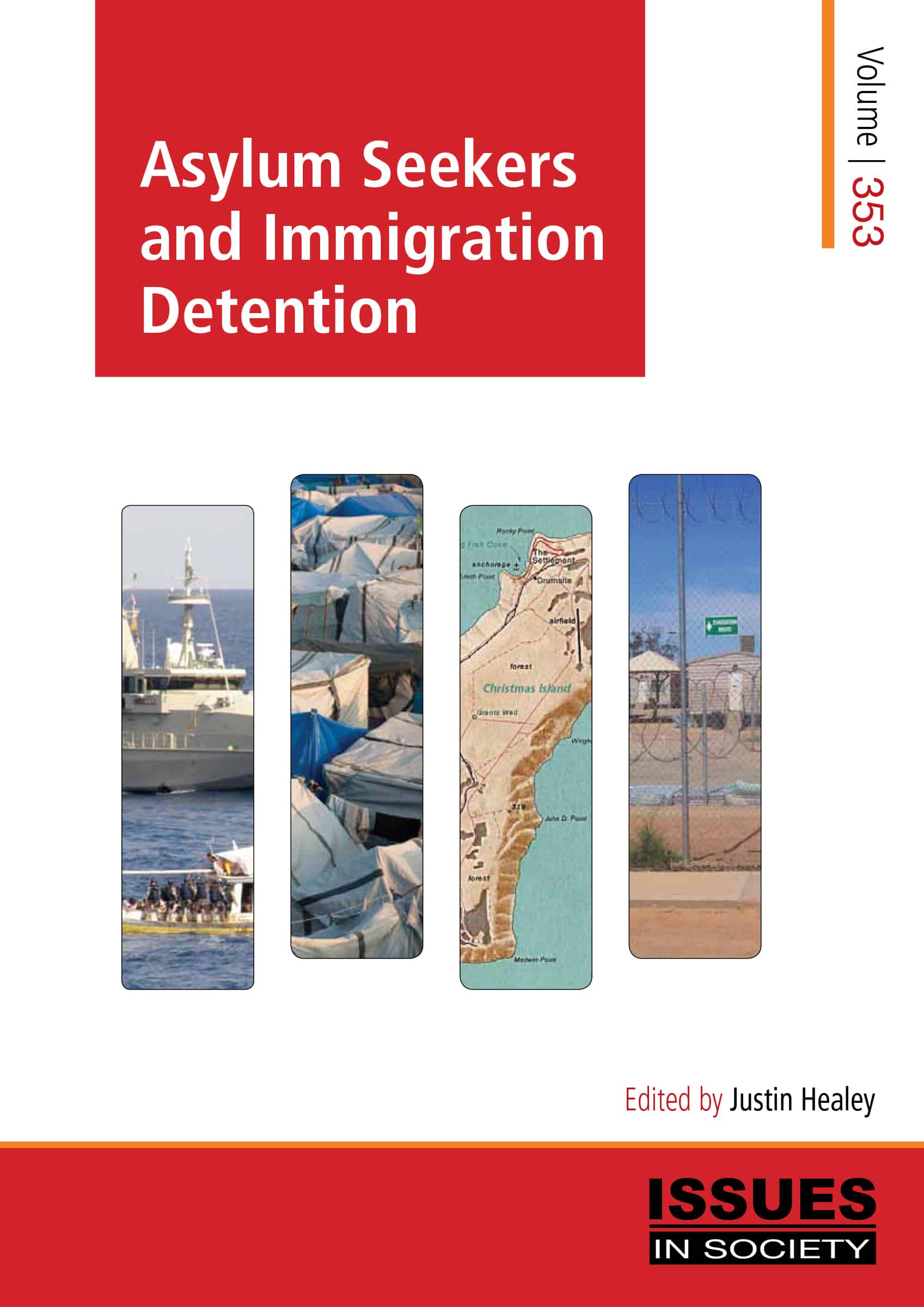
Asylum Seekers and Immigration Detention

Cover - Asylum Seekers and Immigration Detention
  • Asylum Seekers and Immigration Detention
  • Volume 353
  • Editor: Justin Healey
  • Print book ISBN: 978 1 922084 03 3
  • E-book ISBN: 978 1 922084 04 0
  • Year: 2013
  • E-book: $24.00

The record rate of unauthorised and unsafe boat arrivals on Australian shores has further fuelled the longstanding asylum seeker debate and prompted the federal government to seek an effective solution to a seemingly intractable border control problem. The government’s recent policy backdown which resulted in the reintroduction of offshore processing for asylum seekers while at the same increasing the annual refugee intake, has drawn both praise and condemnation.

Should Australia ‘turn back the boats’ of the so-called ‘queue jumpers’ to deter the unsafe and unscrupulous practices of people smugglers? Should Australia maintain offshore processing in other countries such as Nauru and Papua New Guinea (Manus Island), or process asylum seekers onshore in Australia? What are Australia’s obligations to asylum seekers under the Refugee Convention and under its own laws? Is the practice of prolonged mandatory detention adding further trauma to the lives of people who may have already fled from desperate situations in their homelands?

Chapter 1: Australia’s obligations to asylum seekers

Chapter 2: Immigration detention in Australia

Chapter 3: Offshore processing policy debate

Worksheets and activities; Glossary; Fast facts; Web links; Index
Fast Facts

  • In 2010‑11, 65% of visas were granted to people offshore under the offshore humanitarian resettlement program.
  • Until mid-1989, there were fewer than 500 refugee applications a year from people in Australia.
  • Refugee status (protection visa) applications peaked at 16,248 during 1990‑91, with about 77% coming from People’s Republic of China nationals.
  • Australia is one of 147 signatory countries to the Refugee Convention.
  • From 24 March 2012, complementary protection claims will be considered as part of the protection visa assessment process.
  • On 9 August 2008, temporary protection visas were abolished.
  • Protection visa decisions are to be made by the department within 90 days of receipt of the application. The average 90 day processing rate in 2010‑11 was 60.7%.
  • Protection visa applicants rejected by the Refugee Review Tribunal have 28 days to depart Australia.
  • In 2010‑11, the Humanitarian Program delivered 13,799 visas.
  • More than 80% of the world’s refugees are in developing nations.
  • Of the 10.4 million refugees under UNHCR’s mandate as of 2011, the largest numbers were being hosted by Pakistan, Iran, Syria, Germany, Kenya and Jordan.
  • As of 2011, Australia was hosting 23,434 refugees, or 0.2% of the global total.
  • Over 700,000 refugees and displaced persons have settled in Australia since 1945.
  • Until 2009 only a small proportion of asylum applicants arrived by boat – most arrived by air with a valid visa.
  • If you are at risk only because of general violence in your community or because your country is at war – then you are not a refugee.
  • The government will be increasing Australia’s annual refugee intake from 13,750 to 20,000 in 2012-13.
  • Under Australian law, it is never illegal to apply for refugee status here, no matter how you arrive.
  • It would take 20 years to fill the MCG with the number of refugees who come to Australia.
  • In 2010‑2011, Australia’s refugee intake was just 13,799 people, less than 0.14% of the global total.
  • Refugees currently make up just 6.6% of the places in our overall permanent immigration program.
  • In the early 1980s, refugee and humanitarian intake averaged 20% of immigration.
  • Australia’s mandatory immigration detention policy was introduced in 1992 and expanded in 1994.
  • Between 2000 and 2010 the Commonwealth had paid out over $12 m in compensation for alleged injury or wrongful detention to individuals.
  • Of the estimated 200 million asylum seekers who crossed international borders in 2010, approximately one quarter were children.
  • Australia is the only country in the world with a policy of mandatory detention of children.
  • When first introduced, mandatory detention policy applied for a maximum of 273 days. Time limits were removed in 1994, making detention indefinite for asylum seekers.
  • As at 31 March 2012, there were 4,197 people in locked detention facilities, at least 3,800 of whom were asylum seekers. Of these, 428 were children.
  • Amnesty International recommends that a maximum 30-day time limit is placed on the detention of asylum seekers.
  • Placing people in community detention is 90% cheaper that in immigration detention.
  • Temporary protection visas, routinely issued by the Australian Government from 1999 to 2008, were found to be extremely harmful to mental health.
  • In May 1992, the Keating Labor government introduced the Migration Reform Bill that created Australia’s mandatory detention system.
  • As of 15 June 2011, 678 children have been released into community detention.
  • The numbers arriving in Australia are small by international standards (Australia’s proportion is equivalent to 2.5% of all asylum applications internationally, including arrivals by air and sea).
  • In Pakistan there are an estimated 2.7 million refugees and displaced persons and 900,000 in Iran, neither country are signatories to the Refugee Convention.
  • Malaysia hosts around 100,000 refugees and ‘persons of concern’ for the UNHCR, yet Malaysia is not a signatory to the Refugee Convention.
  • There are 42 million displaced people in the world – around 15 million of these are recognised as refugees.
  • There has been a reduction in the average length of detention from 277 days in November 2011 to 86 days in July 2012.
  • 4% of asylum seekers coming to Australia by boat are estimated to have drowned at sea since the Pacific Solution was stopped.
  • Between 70 and 90% of asylum seekers coming to Australia by boat have been found to be genuine refugees.
  • 6,000 asylum seekers and refugees are caned annually in Malaysia.
  • Around 1,500 Asylum seekers were processed on Nauru under the previous government’s Pacific Solution.
  • As of August 2012, the Australian Parliament amended our laws to override our international obligations under the United Nations Refugee Convention.
  • In 2011, Australia took in 21,805 refugees, while last financial year Australia’s total migration and humanitarian intake was 182,500 people. Of these, 92% came from the migration program.