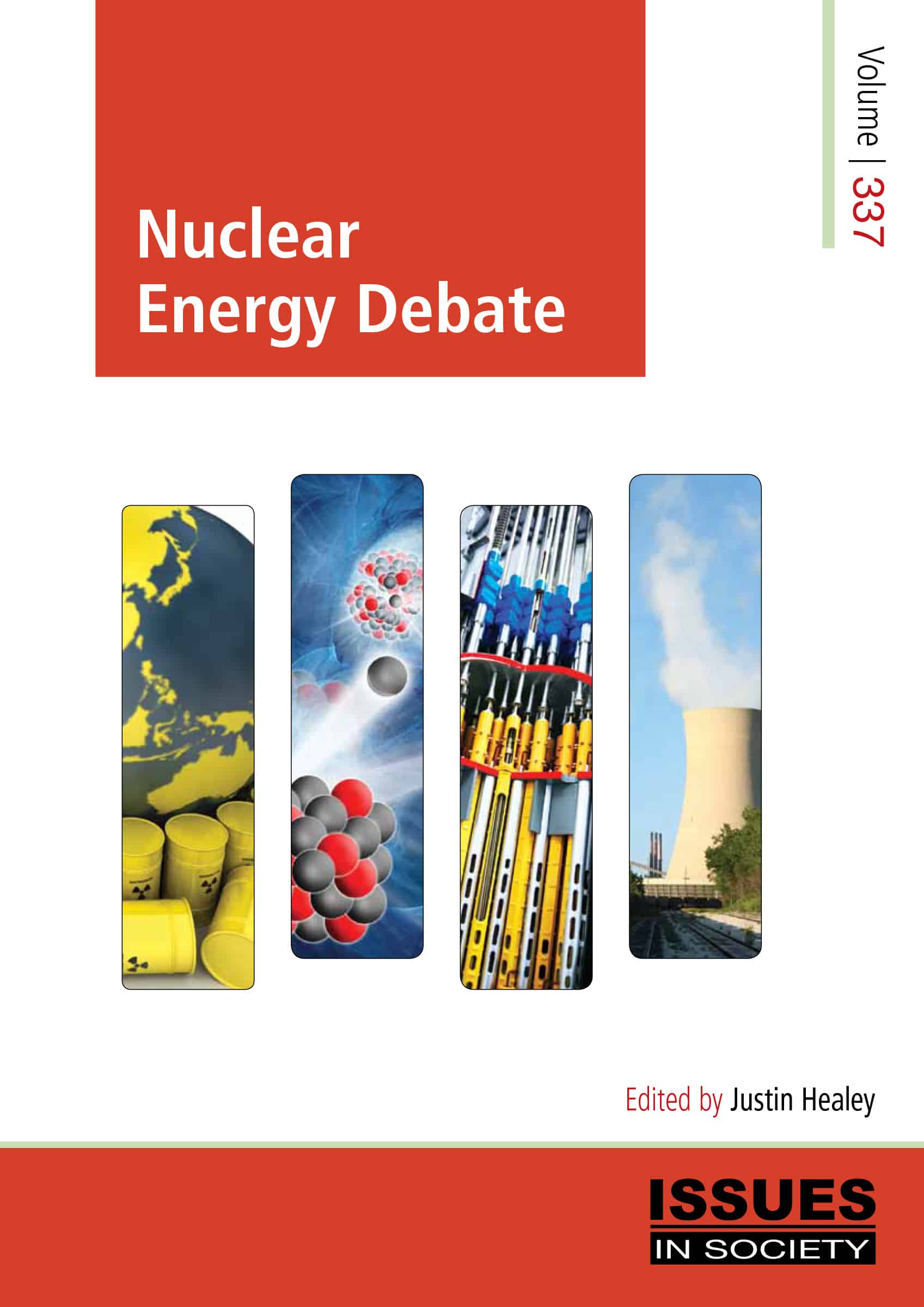
Nuclear Energy Debate

Cover - Nuclear Energy Debate
  • Nuclear Energy Debate
  • Volume 337
  • Editor: Justin Healey
  • Print book ISBN: 978 1 921507 68 7
  • E-book ISBN: 978 1 921507 69 4
  • Year: 2012
  • E-book: $24.00

The debate over the introduction of nuclear power in Australia has recently become more heated in light of safety concerns over the nuclear reactor meltdown emergency in Japan. Australia has also just committed to a carbon trading scheme to address its reliance on coal-fired energy and reduce greenhouse emissions. With 40% of the world’s uranium located in Australia, the economic, environmental and health considerations are significant. This book contains an overview of global nuclear energy use and production, and presents a range of current opinions debating the pros and cons of Australia’s expanded involvement in the nuclear power industry. Should Australia build nuclear reactors for its domestic power supply? How environmentally sustainable is nuclear, what are the costs, and how safe is the storage of radioactive waste? How does nuclear power compare to alternative sources of energy? What safeguards are there to ensure nations who purchase Australian uranium use it for electricity generation and not for nuclear weapons?
Chapter 1: Nuclear power in Australia

Chapter 2: Pro-nuclear energy opinions

Chapter 3: Anti-nuclear energy opinions

Worksheets and activities; Glossary; Fast facts; Web links; Index

Fast facts:

  • The main use of nuclear energy is to generate electricity.
  • Nuclear energy has distinct environmental advantages over fossil fuels, in that virtually all its wastes are contained and managed.
  • 30 countries use nuclear energy to generate up to 3/4 of their electricity, and a substantial number of these depend on it for 1/4 to 1/2 of their supply.
  • Nuclear power reactors are expensive to build but relatively cheap to operate. By way of contrast, gas-fired power plants are very cheap and quick to build, but relatively very expensive to operate.
  • Civil nuclear wastes have never caused any harm, nor posed an environmental hazard, in over 50 years of the nuclear power industry.
  • If used fuel needs to be transported, it is shipped in large and extremely robust steel casks weighing over 100 tonnes, and each holding only about 6 tonnes of fuel.
  • Australia has 23% of the world’s uranium deposits and is the world’s second largest producer of uranium after Canada.
  • The worst nuclear disaster in history occurred in 1986 when a reactor at the Chernobyl Nuclear Power Plant exploded resulting in a nuclear meltdown and a succession of explosions.
  • No country of Australia’s economic size or larger is without nuclear power.
  • Nuclear waste can remain radioactive for thousands of years. It must be stored for all this time away from water into which it can dissolve and far from any tectonic activity.
  • While traces of uranium occur almost everywhere on Earth, the highest concentration is found in the Earth’s crust.
  • Uranium has only become valuable since the explosion of the first atomic bomb in 1945, during World War II.
  • In 2007-08 Australia produced more than 10,000 tonnes of uranium oxide, generating over $A 887 million of export revenue.
  • In 1984 the federal Labor government introduced their three mines policy. The policy was abandoned when the Coalition government was elected in March 1996.
  • High doses of ionising radiation destroy body tissues, and death occurs immediately or soon after exposure.
  • There have been three major reactor accidents in the history of civil nuclear power – Three Mile Island, Chernobyl and Fukushima.
  • The amount of radiation harmful to people depends on which chemical element, and how much of it they are exposed to.
  • Radiation damages cells by breaking chromosomes in DNA. This usually causes the cell to die.
  • Australia’s uranium exports enable other countries to gener-ate electricity that in total exceeds Australia’s electricity production by some 25%.
  • The closest Australia came to a nuclear power station was the Jervis Bay project, which was abandoned in 1971 on cost grounds.
  • Some 430 or more civilian power reactors safely provide over 15% of the world’s electricity.
  • Nuclear wastes arise in three broad categories – low, intermediate and high.
  • Global electricity sector technologies in 2050 will comprise 36% renewables (mainly hydro, wind, solar and biomass), 32% nuclear, 26% carbon capture and storage (CCS) and 6% fossil fuels (without CCS).
  • There is a type of nuclear reactor which cannot meltdown or blow up, and does not produce intractable waste, or supply the nuclear weapons cycle. It’s called a thorium reactor or sometimes, a molten salt reactor.
  • To put energy accidents in perspective, 2,433 people died in coal mine accidents in China in 2005. The number was closer to 2,600 in 2009, and even higher in 2008.
  • Japan has 55 reactors that generate about 30% of its electricity.
  • Most of us are exposed to about 4 millisieverts (mSv) of mainly background radiation each year. Radiation workers are allowed 50 mSv per year.
  • Building 12 reactors in Australia would reduce emissions by 8% if they replaced coal-fired plants yet reductions 10 times as large are required.
  • Countries and regions with a high reliance on nuclear power also tend to have high greenhouse gas emissions.
  • Assuming a world supply of 6-10 million tonnes of uranium and 70% of the world’s electricity were generated by nuclear power, uranium supplies would be exhausted within 20 years.
  • In 2008 and 2009, the world retired 3,000 megawatts of old nuclear capacity and only 1,000 megawatts was brought on line. In the same 2 years, about 60,000 megawatts of new wind power was commissioned.
  • Nobody has yet demonstrated safe permanent management of radioactive waste, 55 years after the nuclear experiment began.
  • The largest volumes of nuclear waste are generated during the fuel chain, i.e. during uranium mining, processing, enrichment and fuel fabrication.
  • Radioactive elements are invisible to the human senses – taste, smell, and sight. Also unfortunately, the incubation time for radiation-induced cancer is 5-60 years, a long, silent latent period.
  • The average age of operating reactors globally is 25 years, while the average age of 123 reactors already closed is 22 years only.
  • Australia’s uranium exports have resulted in the production of over 114 tonnes of plutonium – enough to build 11,000 nuclear weapons.
  • We still don’t have a permanent repository for high level waste anywhere in the world.
  • Total global plutonium production in power reactors each year is sufficient to produce 7,000 weapons.
  • Stockpiles of separated ‘civil’ plutonium amount to over 270 tonnes, enough for 27,000 nuclear weapons.