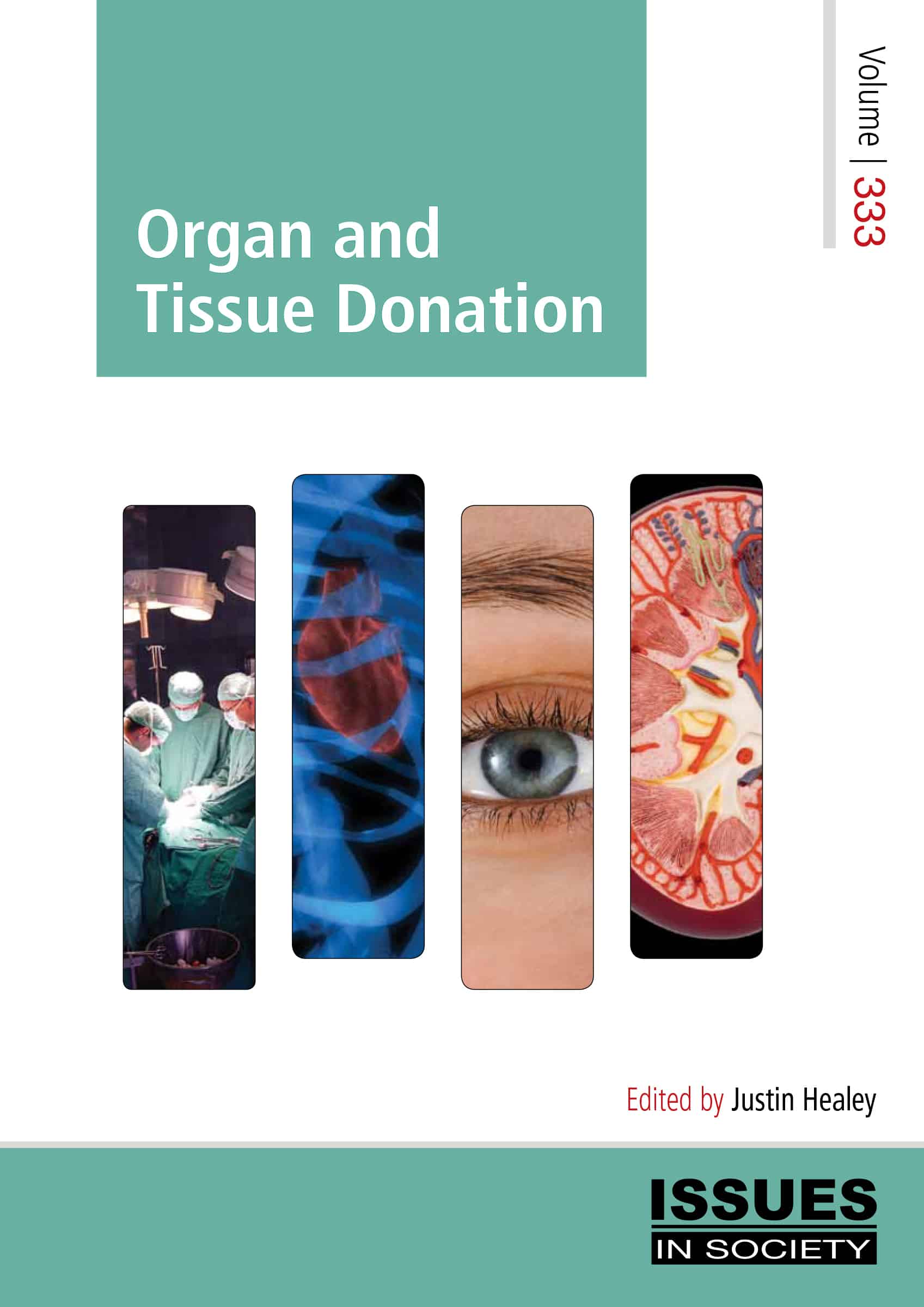
Organ and Tissue Donation

Cover - Organ and Tissue Donation
  • Organ and Tissue Donation
  • Volume 333
  • Editor: Justin Healey
  • Print book ISBN: 978 1 921507 59 5
  • E-book ISBN: 978 1 921507 60 1
  • Year: 2011
  • E-book: $24.00

Organ and tissue transplants can be the last resort for a range of life-saving and life-improving treatments. This opportunity usually only becomes available when someone donates their organs or tissues upon their death. The latest organ donation figures have reached a record high – the generosity of 309 donors and their families saved or significantly improved the lives of 931 Australians in 2010. This organ donation total, however, only equates to a national organ donor rate of 13.8 per million, which suggests more can be done to help Australians who are on transplant waiting lists. What is the government doing to increase community awareness in an effort to boost the organ and tissue donation rate? This book addresses the misconceptions and facts about organ and tissue donation and registration. It also explores a range of ethical issues around consent and objection, such as ‘opt-out’ system proposals, religious considerations, the brain death debate, altruistic living tissue and organ donation, the illegal market in body parts, and animal to human transplantation (xenotransplantation). What does it take to give the gift of life?

Chapter 1: Organ and tissue donation in Australia

Chapter 2: Ethics of organ donation

Worksheets and activities; Glossary; Fast facts; Web links; Index

Fast facts:

  • Biliary atresia is one of the most common reasons that a child might require a liver transplant.
  • Not everyone with end stage organ failure is suitable to receive a transplant.
  • Organ donation is medically possible in less than 1 per cent of all deaths that occur.
  • Organs that can be transplanted include heart, lungs, liver, kidneys and pancreas.
  • Tissues that can be transplanted include eye tissue, heart valves, skin and bone tissue.
  • It has been estimated that between 200,000 and 300,000 people worldwide receive bone transplants each year; more than 25 times the number of people who undergo kidney transplants and 100 times the number who undergo heart transplants.
  • Kidney transplant survival rates are about 90% in the first year and over 75% in 5 years.
  • Patient survival rates for heart and liver transplantation are 90% in the first year and 85% after 5 years.
  • Australia’s first successful heart/lung transplant was in 1986, at St Vincent’s Hospital, NSW.
  • People aged less than 18 years can become organ and tissue donors, although consent will need to be obtained from a family member at the time of death.
  • Three quarters of patients (76%) on the organ transplant waiting lists are between 40 and 69 years of age – 164 people under the age of 30 years are on the list, 29% are children or teenagers (under 18).
  • The 2010 organ donation total of 309 donations, equates to a national organ donor rate of 13.8 per million.
  • There’s no defined cut-off age for donating organs. Organs have been successfully transplanted from donors in their 70s and 80s.
  • Organs are matched by factors, including blood group and tissue typing, which can vary by race, but this does not preclude them from receiving transplants.
  • Organ recipients cannot be tissue donors due to the immun-osuppressive drugs that are taken after the transplant and their harm caused to the body.
  • Australia is internationally recognised for a strong record of successful organ transplantations, but also has one of the world’s lowest rates of organ donations.
  • Organ donation is only considered after several tests are carried out by two appropriately qualified senior doctors to establish whether brain death has occurred.
  • Most religions support organ and tissue donation as generous acts that benefit people. This includes Christianity, Islam, Buddhism, Hinduism and Judaism.
  • There are some 1,700 Australians on official waiting lists at any one time.
  • On average, people on the transplant list must wait between 6 months and 4 years.
  • Around 40% of families in Australia do not give consent. In many cases it is because they do not feel they can confidently make a decision about the wishes of the deceased.
  • There are more than 10,000 people in Australia who are on dialysis. The majority would benefit from a transplant.
  • Spain has the highest rate of organ donation in the world (2.5 times higher than the UK).
  • In 1983, The Muslim Religious Council initially rejected organ donation by followers of Islam, but it has reversed its position, provided donors consent in writing prior to death.
  • Organ donation is often considered unacceptable by the Shinto religion as families are concerned that they not injure the itai – the relationship between the dead person and the bereaved people.
  • Brain death criteria were proposed in 1968 by a Harvard Medical School Committee.
  • In the UK, 1,000 people per year die on the transplant waiting list. In the US, 18 patients per day die waiting.
  • In Australia, the legal definition of brain death involves death of the brain stem, which is necessary for vital functions. In the US, it is death of the whole brain. The Japanese do not use the concept of brain death at all.
  • On average once a week, in a hospital somewhere in Victoria, a deceased patient becomes an organ donor.
  • In living donation, the transplant operation can take place straight after the donation operation. This means that the transplanted organ starts working again more quickly.
  • There are about 20 million spare kidneys in Australia – one for each man, woman and child.
  • In Australia about 9,000 people are alive on dialysis and only about 5 per cent of patients are offered a kidney transplant in any year. The average waiting time for a transplant is four years. About one patient a week dies waiting for a kidney. The cost of dialysis is over $500 million per year.
  • The number of commercial transplants globally has dropped from about 10,000 to 2,000 in the past few years, creating an enormous demand for organs.
  • Some animal devices, such as pig heart valves, have been used in humans for many years.
  • Many countries have decided to allow animal to human transplantation clinical trials including New Zealand, USA, Mexico, Russia, Germany, Switzerland, Malaysia, Ukraine, Sweden, France, Italy and China.
  • Outside of Australia, over 200 people have been exposed to pig cells and tissues through animal to human transplantation.
  • Implanting insulin-producing islet cells from pigs into the pancreas could allow people with severe type-1 diabetes to start producing their own insulin in response to fluctuating blood glucose levels.
  • Pigs are now considered the donor animals of choice because they are physiologically similar to humans.
  • A single gene that is active in pigs, but not in humans, is responsible for 95% of the antibodies we produce when exposed to pig tissue.