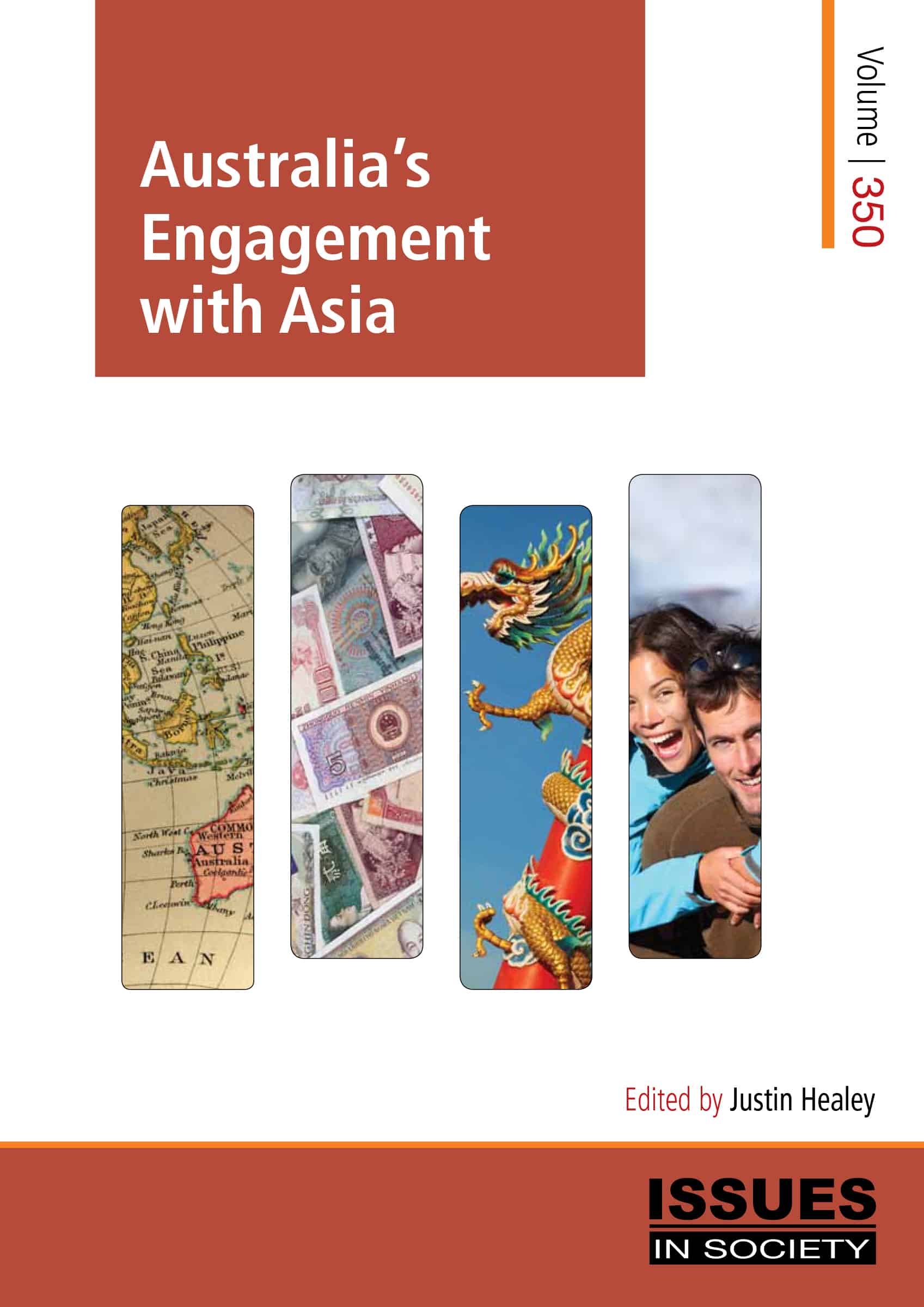
Australia’s Engagement with Asia
- Australia’s Engagement with Asia
- Volume 350
- Editor: Justin Healey
- Print book ISBN: 978 1 921507 97 7
- E-book ISBN: 978 1 921507 98 4
- Year: 2013
- Print book: $24.00
- E-book: $24.00
The pace and scale of Asia’s rise during the ‘Asian Century’ has been nothing short of staggering. Asia is on course to become the world’s largest economic region before the end of this decade, presenting Australia with a range of opportunities and challenges.
This book aims to develop a better understanding of the economic, political and cultural interconnections that Australia has with its Asian neighbours. Trade and investment, education, language capability, defence and strategic policy are all key concerns in relation to Australia’s engagement with Asia. Improved Asia literacy is particularly important for young Australians who will need to develop skills to communicate and engage with the peoples of Asia in order to effectively live, work and learn in the region.
What are the implications of the Asian Century for Australia’s economic, social, political and strategic environments? Is Australia ready for the Asian Century?
Chapter 1: Australia in the Asian Century
Chapter 2: Trade and investment
Chapter 3: Defence and strategic policy
Worksheets and activities; Glossary; Fast facts; Web links; Index

Fast facts
- The Australia in the Asian Century White Paper sets out a comprehensive agenda for making the most of the opportunities ahead. It considers how Australia will successfully navigate the years ahead across five areas: strengthening our economy; building our capabilities; connecting to growing markets; ensuring sustainable security; and nurturing deeper and broader relationships.
- Within only a few years, the Asian region will not only be the world’s largest production zone, it will be the world’s largest consumption zone. Asia will not only remain home to the majority of the world’s population, but will be home to the majority of the world’s middle class.
- By the end of this decade, Asia is set to overtake the economic output of Europe and North America combined to become the world’s largest economic power.
- By early next decade, the combined output of China and India is expected to exceed that of the whole Group of Seven (G7).
- Average GDP per person in Asia is set to almost double by 2025 – a feat that took the United Kingdom over 50 years to achieve during the Industrial Revolution.
- By 2025, four of the ten largest economies in the world are expected to be in the Asian region, and Asia is likely to account for almost half of the world’s economic output.
- Between now and 2025, China and India are expected to make the largest contributions to global and regional economic growth relative to any other national economy. Indonesia, Malaysia and other countries in Southeast Asia will also grow rapidly and make major contributions to regional growth.
- Productivity gains are expected to underpin rapid growth in Asia into the next decade, notwithstanding short-term volatility in the global economy.
- There is significant potential for continued labour productivity growth, with output per person in China only 20 per cent of that in the United States, while India and Indonesia have barely reached 10 per cent.
- Even under a slow growth scenario – assuming that productivity gains are 50 per cent less than anticipated – Asia will still be the fastest growing region in the world, with four of the ten largest economies in the world still projected to be in Asia by 2025.
- By 2025, Asia will account for nearly half of world output. Even under conservative growth scenarios, three out of the world’s five largest economies will be in Asia. By the same year, income per person in Australia will be in the world’s top 10, up 18% from its current level.
- Asia’s economic rise is not a new phenomenon. Yet according to ABS data, over the past decade the five key countries identified in the White Paper – China, India, Indonesia, Japan and Korea – only accounted for 9.6% of the increase in the foreign capital stock in Australia. If Japan is taken out of the calculation, then the number falls to just 3.3%. These figures are alarming and certainly do not constitute starting from a position of strength.
- The OECD projects that the proportion of the world’s middle class residing in Asia will increase from 28 per cent in 2009 to 66 per cent by 2030. The growth of the Asian middle class means a massive increase in consumption and spending on imported goods and services, the supply of which Australia is well placed to provide.
- Asia literacy requires education to produce a strong cohort of Australians fluent in an Asian language and all young people to be equipped with knowledge of Asia through History, English, Geography, Arts, Maths and Science throughout their schooling.
- According to 2011 Census data, approximately 2.2 million people speak Asian languages at home, which equates to around 10% of the population. Important Asian languages are very well represented within the overall number of speakers of Asian languages.
- Seven of the top 10 source countries in Australia’s 2011-12 immigration program were from Asia: China, India, Malaysia, the Philippines, South Korea, Sri Lanka and Vietnam.
- The 2011 Census data shows that the leading birthplace of immigrants who arrived in Australia between 2006 and 2011 was India (13.1%), which represents a 100% increase on the 2006 Census data. During the same period, the number of immigrants born in China increased by 54%, while the number from the Philippines increased by 42%.
- From antiquity until the middle of the 19th century, China and India were the two largest global economies, accounting for about half the world’s economic output. Their current climb up the GDP rankings restores them to where history and population predicts they should be.
- Asia’s share of world output has doubled in under 60 years – from roughly 20 per cent in the 1950s to nearly 40 per cent in 2010. With growth of that order expected to continue, there can be little doubt we live in the ‘Asian Century’.
- Three of Australia’s five biggest trading partners – China, Japan and Republic of Korea – are in Asia. And, since 2004, Australia conducts more trade with Asia than with the rest of the world combined.
- The Asian share of the stock of foreign investment in Australia in 2011 was only 12.87%, or 6.87% minus Japan. In contrast, the shares of the US and UK stood at 27.94% and 24.02%, respectively. For all the talk of behemoth Chinese state-owned entities buying up Australian mining and farming assets, the Chinese share of the stock was less than 1%. In 2010, Chinese investment in Australia actually fell to $1.65 billion, down from $7.82 billion a year earlier.
- Australia has been a key player in efforts to develop and improve security co-operation in Asia, but it is a lead player in the region’s defence expenditure escalation. Central to that process has been the long-running efforts to tighten Australia’s alliance with the US – something which hasn’t escaped Beijing’s attention. Efforts to drive co-operation in Asia will be limited by Australia’s own policy choices.
Book topics
Download catalogue
Download the latest catalogue with order form to post or fax to us directly.
Download now