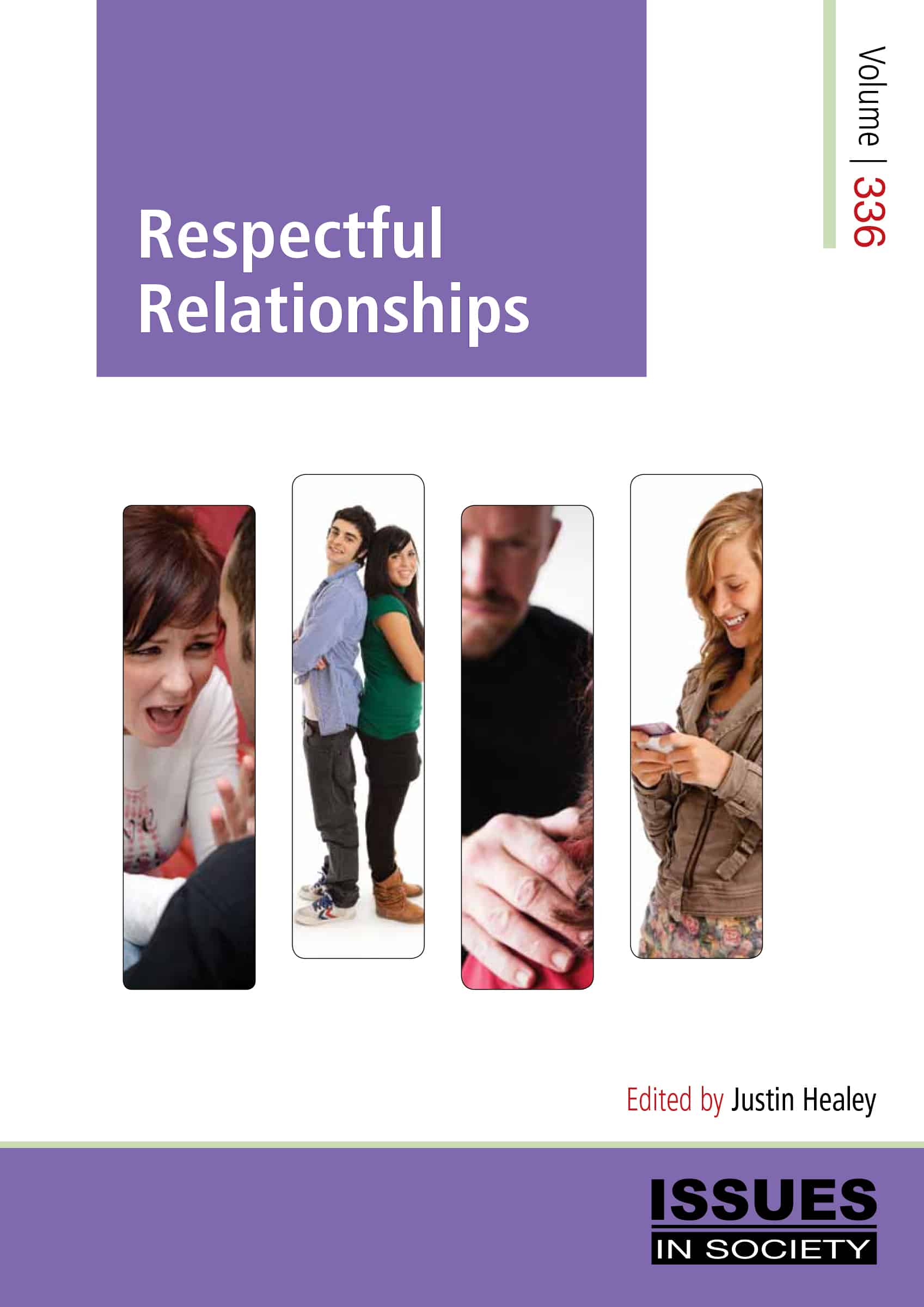
Respectful Relationships
- Respectful Relationships
- Volume 336
- Editor: Justin Healey
- Print book ISBN: 978 1 921507 66 3
- E-book ISBN: 978 1 921507 67 0
- Year: 2012
- Print book: $24.00
- E-book: $24.00
We all have our own needs at different times within relationships, and it is important to give and take in terms of these needs and to show each other respect. Everyone has the right to feel safe, to be treated fairly, and to be valued and accepted for who they are. This book examines how young people can negotiate their relationship needs respectfully and safely in partner relationships, friendships and family relationships. Issues addressed in this book include peer pressure and teen friendships; dating pressures and sexual coercion; domestic violence and abusive relationships; and managing anger and conflict. How do young people identify abusive behaviours in intimate relationships and learn to behave in positive and respectful ways?
Chapter 1: Friendships and family relationships
Chapter 2: Couple relationships
Chapter 3: Abuse and conflict in relationships
Worksheets and activities; Glossary; Fast facts; Web links; Index
Fast facts:
- Everyone has the right to feel safe, to be treated with fairness, to be valued and feel accepted for who they are.
- In a study, the impact of finances on couple relationships was explored, with 71% of respondents indicating that financial problems were more likely to push couples apart and 11% indicating they would keep couples together.
- Teenage girls tend to have one or two best friends – the focus is on empathy, self-disclosure, support and nurturing.
- Teenage boys tend to have larger friendship groups that give them companionship and competition.
- Toxic friendships can lead to your child having more negative feelings about himself or others.
- Friendship problems and break-ups can sometimes lead to bullying.
- Friends play an important role in the psychological dev-elopment of adolescents.
- Peer pressure may influence a teenager to engage in risk-taking or anti-social behaviour.
- Once a photo or a personal confidence leaves your computer and goes to someone else’s, you can’t control where it goes next.
- Parents and carers play an important role in assisting children and young people to develop the values and skills needed to express respect to others and themselves in their daily lives.
- Respect is a key step in building strong relationships. When it is absent or lacking, conflict or relationship breakdown often occurs.
- Adolescence is a crucial period for young people to learn how to develop and maintain respectful relationships with others.
- Assertiveness skills can assist young people to deal with a range of life experiences where they may feel pressured to do things they don’t want to do or put out of their comfort zone
- When your family sets rules, boundaries and standards of behaviour, it gives a child a sense of consistency and predictability.
- Enjoying the company of a number of people like your friends, and not just the person who you are having a relationship with, may help you to expand your interests and give you lots of new things to share.
- A relationship is based on choice rather than dependency – two partners, who are not afraid to be independent, who choose to be together and to be intimate.
- Trust and respect are essential ingredients for a good relationship – with family, friends or in a romantic or sexual relationship.
- Any person who inflicts violence on another (verbal, physical or sexual) is committing a crime.
- Open and honest communication is essential to building a healthy relationship.
- Each partner in a relationship should have equal ability to make choices and decisions about matters that affect the relationship.
- Skills required for good communication include listening, understanding the other person’s perspective, having the ability to negotiate a compromise or being able to agree to disagree.
- There are no obligations to have sex with a partner – no timeframes within which you have to have sex. It is up to you and your partner should respect that.
- Jealousy and possessiveness are two of the most common early signs of abuse in a relationship.
- In a positive relationship, both partners feel valued, loved and nurtured.
- Dating violence is a form of family and domestic violence.
- Regardless of the relationship, sex without consent is rape.
- Intimacy in a relationship means being able to share the whole range of thoughts, feelings and experiences we have as human beings.
- Abuse or violence in a relationship destroys trust and intimacy and signals that the relationship is in trouble.
- Whenever anyone does something to dominate and control their partner, it’s abuse.
- Anger is an emotion. Abuse or violence is behaviour to control a situation or a person. People can get angry without getting abusive.
- It’s not OK to be physically threatened or scared into things that make you uncomfortable or unhappy just because you are in a relationship.
- A violent relationship may not be violent all the time. Some of the time, violent people treat their boyfriend or girlfriend very well.
- Non-physical forms of abuse can be just as damaging as physical violence.
- Speaking out about your experiences is difficult but it is the most important step towards a life without abuse.
- Children are affected by domestic and family violence even if they have not seen the abuse or violence.
- Violent behaviour gives children inappropriate messages about the way to treat people in their family, those they care for, or people with a disability, illness or impairment.
- Some of the effects of domestic violence on children can include feelings of fear, mistrust, shame, anger, helplessness, low self-esteem and depression.
- While recognising that some women are violent, in the large majority of cases it is more likely men than women who are violent and abusive.
- Abuse, bullying and violent behaviour often becomes a pattern of behaviour.
- In the absence of violence, a certain amount of conflict is a sign of a mature and trusting relationship.
- Common stress triggers for conflict include facing a crisis, having a baby, making a significant decision, moving house or changing jobs.
- Noticing early warning signs of relationship breakdown can help a couple resolve conflicts.
Book topics
Download catalogue
Download the latest catalogue with order form to post or fax to us directly.
Download now