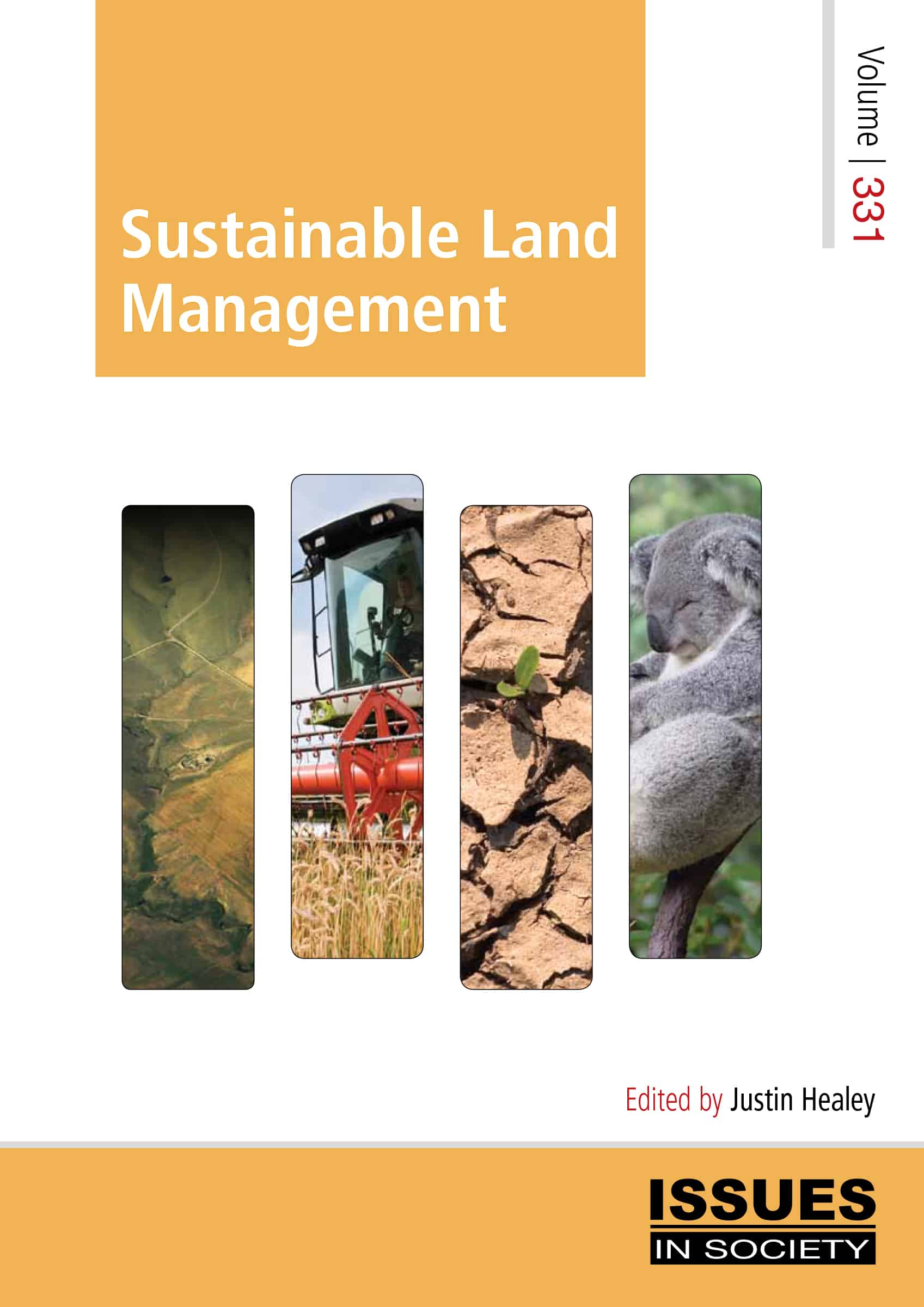
Sustainable Land Management

Cover - Sustainable Land Management
  • Sustainable Land Management
  • Volume 331
  • Editor: Justin Healey
  • Print book ISBN: 978 1 921507 55 7
  • E-book ISBN: 978 1 921507 56 4
  • Year: 2011
  • E-book: $24.00

Land degradation can have severe economic and environmental consequences. Almost two-thirds of land in Australia has been modified for human use, primarily for grazing on natural vegetation. Clearing of native vegetation continues to occur for agriculture, plantation forestry, and urban development. Over the past two centuries, as land use has intensified for a growing population in this arid land, vast areas of native vegetation have been cleared or degraded, resulting in adverse affects on biodiversity, soil and water quality and the spread of weeds, feral pests and diseases. This book examines the damaging impacts of Australia’s land use and agricultural activity, and proposes improvements to current farming systems, including more sustainable use of water and soil, and development of new systems for irrigation, fertilisation and water use. To ensure long-term sustainability, land managers need to consider economic, social and environmental factors. How do we meet the needs of the present without depleting our natural land resources and compromising the future?

Worksheets and activities; Glossary; Fast facts; Web links; Index
Fast facts:

  • It is estimated that up to 40% of the world’s agricultural land is seriously degraded.
  • Almost two-thirds (63%) of land in Australia has been modified for human use.
  • Land classified as ‘conservation and natural environments’ account for just over a third of Australia’s area. About 12% is formally protected in reserves or protected areas.
  • Overcutting of vegetation occurs when people cut forests, woodlands and shrublands at a pace exceeding the rate of natural regrowth.
  • Many land degradation problems developed as a result of the land being used for a purpose for which it was not suitable.
  • Australia’s agricultural landscapes support a wide range of soils. Most are ancient, strongly weathered and infertile by world standards, with deficiencies in phosphorus and nitrogen.
  • With the exception of Antarctica, Australia is the world’s driest continent. More than a third of the continent is effectively desert; over two-thirds of the continent is classified as arid or semi-arid.
  • In the first 8 years of this century, Australia experienced two of the worst droughts on record.
  • In areas of effective rainfall of more than 9 months, generally only higher value crops or tropical crops and fruits are grown.
  • Since European settlement the vegetation of Australia has altered significantly – forest and woodland vegetation systems have been cleared, predominantly for agricultural activity.
  • In spite of Australia’s harsh environment, agriculture is the most extensive form of land use.
  • In 2006-07, irrigated agricultural land comprised less than 1% of all agricultural land in Australia.
  • Climate change is creating a shift in our communities with many individuals and businesses developing plans to save water, energy and carbon.
  • Organic farming aims to produce food of high nutritional value without the use of artificial fertilisers or synthetic chemicals.
  • Good soil management is the core of sustainable agriculture.
  • Natural Sequence Farming is an approach developed in the Hunter Valley of NSW to control the flow of stream water using low-key diversion structures.
  • Plantations provide shelter for stock, prevent wind and water erosion, conserve water resources, protect soil, reduce salinity and provide habitat for native plants and animals.
  • Australia is 1 of only 17 ‘mega-diverse’ countries, with ecosystems of exceptional variety and uniqueness.
  • Loss of biodiversity is considered by some as Australia’s most serious environmental problem.
  • The Natural Reserve System is dedicated to the protection and maintenance of biological diversity and of natural and cultural resources.
  • In Australia, the annual cost of pest species has been estimated at around $720 million.
  • The cane toad is an introduced feral animal that was introduced into Australia as a biological control against cane beetles that destroy sugarcane crops, but failed to control the cane beetles and became a major pest itself.
  • There are a range of Commonwealth, state and territory and local government programs directed at improving biodiversity on farms.
  • Sustainable farm practices maintain or improve Australia’s ability to produce food and fibre while enhancing the capacity of agricultural lands to provide other ecosystem services, such as clean air and water, healthy soils and biodiversity conservation.
  • Meeting the needs of the present without compromising the ability of future generations to meet their own needs is the key principle behind the concept of sustainability.
  • As a major agricultural exporter, Australia feeds not only its own population but also some 50 million people in other countries.
  • Around 2.5 million hectares of Australia’s agricultural lands are currently affected by dryland salinity.
  • Australia has more than 33 million hectares of farming land with acid soils, which cost the nation around a billion dollars in lost income every year.
  • As farmers manage up to 70% of the Australian landscape, their choice of land management practice has a crucial role to play in the future of Australia’s natural resource base.
  • The most effective way of controlling or minimising wind erosion is by maintaining and improving ground cover.
  • Soil has the ability to store, or sequester, carbon dioxide which then means less carbon is released into the atmosphere.
  • Environmental issues associated with sheep and cattle grazing include habitat loss, surface soil loss, salinity, and soil and water quality issues.
  • Each Australian uses an average of about 1 cubic metre of timber products per year in items like home construction, paper products and furniture.
  • Australia had about 2.0 million hectares of commercial timber plantations. That compares with about 147 million hectares of native forests and woodlands and 469 million hectares used for agriculture.
  • Weeds are one of the major threats to the natural environment.
  • It is estimated that weeds cost Australian farmers around $1.5 billion a year in weed control activities and a further $2.5 billion a year in lost agricultural production.
  • There are two kinds of soil salinity – irrigated land salinity and dryland salinity.
  • Feral grazing animals and livestock diminish the supplies of food and shelter for native fauna.